
_edited.png)
Dear Mr Kinsella: “Participation Is Not a Rort.”
- Peter Gregory

- Mar 17
- 4 min read

Essay Summary:
This essay critiques the media framing of NDIS spending on community participation supports, such as assistance to go for walks, attend social activities, or access everyday services. It argues that portraying these supports as frivolous spending misunderstands the purpose of the National Disability Insurance Scheme Act 2013, which is to enable people with disability to live independently and participate in community life.
The analysis shows that the NDIS does not fund the activities themselves but the support required for many participants to safely leave their homes and engage with society. By framing these supports as wasteful, commentators such as Mr Kinsella from the Australian Financial Review risk undermining the scheme’s core objective of social inclusion and reinforcing outdated institutional thinking about disability.
Ultimately, the essay argues that community participation supports are not optional extras but essential infrastructure that enables citizenship, dignity, and inclusion for people with disability.
The original article by Luke Kinsella in the Australian Financial Review under the title "NDIS spends $12b on support for walks, movies, haircuts" can be found by following this link:
Reflection:
Our community woke this morning to yet another attack on the NDIS by Luke Kinsella in the Australian Financial Review under the title "NDIS spends $12b on support for walks, movies, haircuts". Dr George Taleporos, amongst many others, drew our attention to this piece of fiction in his LinkedIn post.
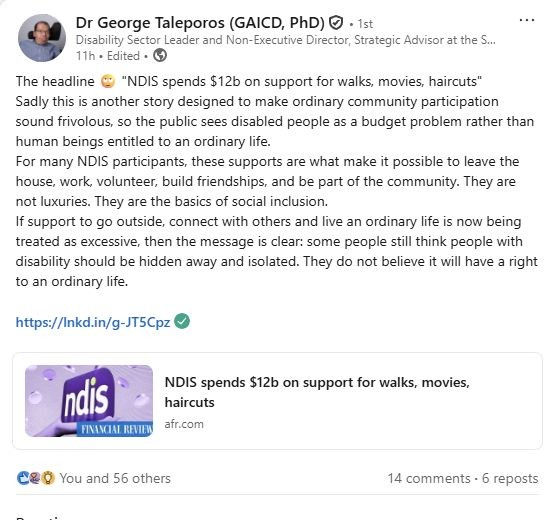
The analysis in this article is problematic for several conceptual, methodological, and ethical reasons. At its core, it reflects a misunderstanding of the purpose of disability support, uses misleading framing, and ignores the evidence base underpinning community participation supports in disability policy and human rights frameworks.
Below are the key issues.
1. Misleading Framing: “Walks, movies and haircuts”
The headline frames the spending as frivolous lifestyle activities. However, these are not the support being funded. The NDIS funds assistance required to access the community, not the activity itself. For example:
The participant pays for the coffee, haircut, or cinema ticket.
The NDIS funds the support worker required for the person to leave the house safely.
For many people with high support needs this assistance is equivalent to mobility access, not recreation. The framing creates a false perception of waste.
2. Failure to Recognise the Purpose of the NDIS
The article implicitly assumes the NDIS exists primarily to fund clinical or medical interventions. This contradicts the legislated objectives of the scheme in the National Disability Insurance Scheme Act 2013.
The Act explicitly aims to support:
Social and economic participation
Independent living
Community inclusion
Community participation supports are therefore not peripheral spending. They are central to the purpose of the scheme.
3. Ignoring the Evidence Base
The article implies the value of community participation is unclear. In reality, decades of disability research demonstrate that community participation leads to:
improved mental health
reduced isolation
improved physical health
increased employment prospects
reduced long-term service dependence
These outcomes are well documented in disability policy literature and were central to the design recommendations of the Productivity Commission when it proposed the NDIS. Community participation is, therefore, a preventative investment, not discretionary spending.
4. The “Value for Money” Category Error
The article assumes value can only be measured through direct economic outputs. This misunderstands disability policy. Many supports funded by the NDIS produce social value rather than financial return, including:
dignity
inclusion
freedom of movement
participation in society
These outcomes align with the principles of the United Nations Convention on the Rights of Persons with Disabilities, particularly Article 19: Living independently and being included in the community. Evaluating these supports purely as financial expenditures is therefore a category mistake.
5. Selective Presentation of Data
The analysis highlights the large total figure ($11.6B) but omits important context:
It represents support for hundreds of thousands of participants.
It covers millions of hours of support.
Community participation supports replace institutional care models, which historically cost governments far more. Without this context, the figure appears artificially alarming.
6. Structural Bias Toward Provider Perspectives
Most quoted voices are:
economists
think tank analysts
service provider representatives
The article notably does not quote NDIS participants themselves. This replicates a long-standing problem in disability policy debates: discussions about disabled people without disabled people.
7. Reinforcing Institutional Thinking
The underlying logic suggests that people with disability should only receive support for:
basic survival
medical needs
personal care
This is essentially the institutional model of disability support that existed before the NDIS. The NDIS was created specifically to replace that model with citizenship and participation.
8. The “Rorting” Narrative
Claims that this area is the “easiest place to rort” are presented without evidence. This reinforces a political narrative that disabled people are potential fraud risks, which:
erodes public support
increases stigma
legitimises restrictive reforms
9. Misinterpretation of Cost Growth
The article suggests growth is driven by community participation spending. However, major drivers of NDIS growth include:
increased participant numbers
workforce shortages increasing prices
thin markets
administrative complexity
housing and complex support needs
Community participation spending is therefore not a uniquely problematic category.
The Deeper Problem
The analysis reflects a deeper philosophical conflict:
Is disability support about care or citizenship?
The NDIS was designed around citizenship, enabling people with disability to participate in society like everyone else. When the support required for that participation is reframed as wasteful spending, the scheme’s foundational purpose is undermined.
To summarise:
The article treats community participation supports as discretionary lifestyle spending when they are actually core infrastructure enabling disabled people to exist in the community rather than institutions. Driven by clickbait-fueled ableism, the author of this article has fallen into the trap of believing that overcoming decades of institutional paternalism can be rendered null by simplistic solutions formulated at a distance from disabled people.... the same misguided perception, I might add, that underpins the disastrous New Framework Planning process being cobbled together ineffectively by the NDIA and it's Departmental Ministers and their misguided support for the discredited I-CAN categorisation tool.


Comments